
Searching Baldwin County Civil Dockets
Use the Georgia Courts E-Access directory for Baldwin Superior and State cases. Both point to PeachCourt, and the state says an account is required. The Baldwin clerk page also links a local Online Case Search. Its host timed out during research, so keep PeachCourt and clerk channels ready.
Start with the court named on a summons or notice. Use the exact case number when known, or a full party name and approximate year. Small claims, dispossessory, and garnishment matters require the separate Magistrate route.
- Select Baldwin County, civil case information, and the correct court.
- Search by exact number first, or by party name and year.
- Match the court, parties, type, filing date, and status.
- Trace service, answer, motions, orders, settings, and outcome.
- Request the filed judgment or a certified copy when needed.
Baldwin Civil Courts Compared
The three-way civil split is the key routing fact. Superior hears general civil, domestic, equity, and land-title work. State hears civil matters within its statutory jurisdiction. Magistrate handles non-domestic claims through $15,000, dispossessory, and garnishment.
| Court | Typical docket | Channel |
|---|---|---|
| Superior | General civil, domestic, equity, land title | PeachCourt, local search, unified clerk |
| State | State Court civil jurisdiction | PeachCourt, local search, unified clerk |
| Magistrate | Claims through $15,000, eviction, garnishment | Separate local system and clerk |
Probate and city matters have their own custodians. Juvenile and protected family files may be confidential.
Inside a Baldwin Civil Docket
A civil docket records the order in which events reached the court. Exact Baldwin screen labels could not be sampled because the local portal did not load and provider access is account-gated. Look for these record elements while keeping the event list distinct from the filed papers.
| Identity | Court, case number, filing date, status, and case type. |
|---|---|
| Parties | Plaintiff or petitioner, defendant or respondent, and counsel. |
| Pleadings | Complaint, service, answer, counterclaim, and amendments. |
| Events | Motions, signed orders, notices, calls, hearings, and trials. |
| Outcome | Judgment, dismissal, agreed order, satisfaction, writ, or appeal. |
Baldwin Motions Versus Orders
A motion is a party's request. An order is the court's ruling. Seeing a motion on the Baldwin civil docket does not show that relief was granted. Read forward for a signed order, hearing, amendment, or final judgment. A service entry also records a notice step, not a win.
Discovery is often not filed in full. Its absence from the docket does not prove none occurred. When the exact ruling matters, note the date and title and obtain the actual filing.
Civil outcomes also need careful labels. A default judgment follows a failure to defend after required steps. A voluntary dismissal or nonsuit is not a judgment after trial. An agreed judgment reflects terms entered as a judgment, while a judgment for plaintiff or defendant records an adjudicated result. Georgia's Baldwin calendar does not establish use of the Texas term DWOP, so that foreign abbreviation should never be read into a local entry. Later garnishment, writ, satisfaction, post-judgment motion, or appeal events may show that the file continued after judgment.
Read in sequence: Complaint › Service › Answer › Motion › Order › Setting › Judgment.
Civil Case Types on the Docket
Baldwin civil records span more than damage suits. Court class and case type determine the correct search and custodian.
- General civil, tort, contract, equity, and land-title matters.
- Divorce and domestic relations, subject to privacy limits.
- State Court civil matters within its jurisdiction.
- Magistrate claims through $15,000 and dispossessory cases.
- Garnishment and related post-judgment work.
The $15,000 line applies to non-domestic Magistrate civil claims, not as a State Court ceiling. Case status also needs context. An active label does not show which party is ahead. A closed label does not explain whether the result was dismissal, settlement, default, or judgment after trial. Read the latest outcome event and obtain the signed paper. If an appeal appears, the notice begins a separate review path and does not erase the Baldwin trial docket.
Baldwin Magistrate Search Is Separate
The official Magistrate Court page describes its jurisdiction and separate civil system. A PeachCourt search cannot be treated as complete for an eviction, garnishment, or small claim.
The official Magistrate endpoint is shown below.
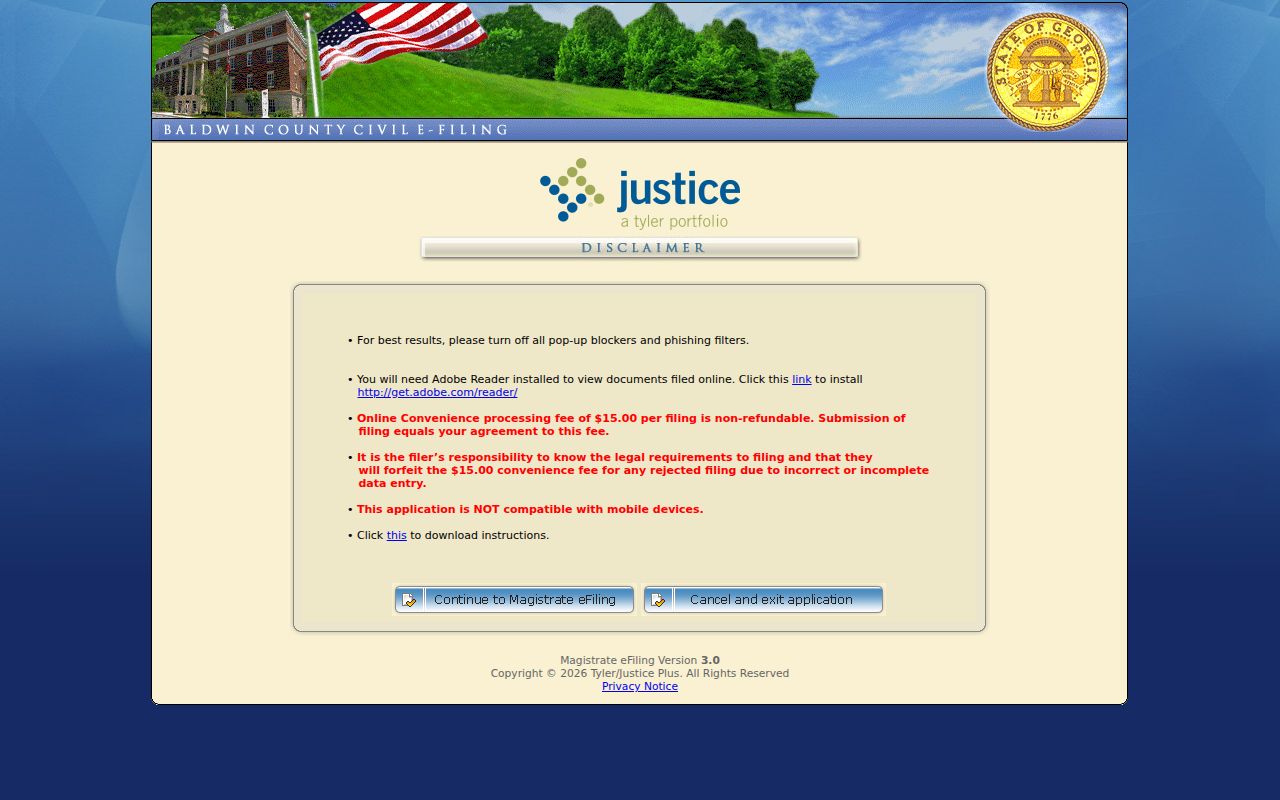
If it does not return a known case, call 478-445-4446 or write P.O. Box 141, Milledgeville, GA 31059. Give names, year, and number if known.
Civil Docket Settings and Hearings
The annual Superior calendar uses local labels. A double asterisk marks civil calendar call, CV marks civil trials, MD motion day, SC status conference, NJ non-jury, and SS special set. These are planning blocks, not party-level notices.
Read the newest event and later orders for resets. Then verify with the clerk, as the Ocmulgee Circuit directs. The Baldwin calendar index posts separate court calendars.
A civil calendar call can address readiness or scheduling without being the trial itself. A motion day may cover a particular request, and a non-jury block identifies the manner of hearing rather than the merits. If the annual schedule and the case notice conflict, record the case number, event date, and judge or assignment shown. Ask the responsible Baldwin division which filed notice controls. A telephone inquiry is a way to verify an order, not a continuance by itself.
Note: Never miss a hearing because a block calendar looks blank or uses an unfamiliar code.
Georgia Rules Shape Baldwin Dockets
The Georgia legislation gateway supplies current Code sources affecting civil procedure and access.
Use current text with the relevant court rule, since judicial records are not governed by a generic open-record statement alone.
The Georgia Supreme Court rules hub provides the related official framework.
The Baldwin clerk or Magistrate custodian still handles the actual case file and copy request.
Baldwin Civil Docket Access Rules
Ordinary civil events may be searched or requested from the clerk. Adoption, some domestic matters, sealed exhibits, and unredacted sensitive data can be withheld. Georgia filing rules limit Social Security, taxpayer identification, and financial account numbers to their last four digits.
For Superior or State records, visit Suite 209, 121 North Wilkinson Street, weekdays 8:30 a.m. to 5:00 p.m.; call 478-445-4007 or 478-445-6324; or mail P.O. Box 987, Milledgeville, GA 31059-0987. State the court, number, parties, year, exact document, and plain or certified status. Ask for current fees.
Key Rules:
Georgia Open Records Act is a broad public-record law, while judicial records also follow court rules and judicial authority.
Georgia e-filing standards address public access, sealing, and protected identifiers.
Sealed content requires legal authority, not a different search method.
Baldwin Certified Civil Judgments
A docket, filed judgment, and certified copy are three layers. The docket says what happened and when. The judgment contains the court's words. Certification authenticates a copy. A screen print is not certified.
The GSCCCA eCertification system takes electronic requests after login. Choose county and court, then follow its prompts. Its public authentication lookup only checks a certification already issued. Paper requests go to the Baldwin clerk.
A useful civil copy request names the court and case number, gives the caption and approximate year, identifies the exact judgment or event date, and states whether a plain or certified copy is needed. Include contact and delivery details and ask whether prepayment or identification is required. A transcript follows a different channel through the court reporter or judicial office. Sealed exhibits also require authority beyond an ordinary copy request.
For older files, give an approximate year. The 1847 courthouse burned in 1861, so an archive inquiry is wise, but that history does not prove every early record was lost.