
Searching Baldwin County Criminal Dockets
Begin at the official Georgia Courts E-Access directory. It routes both Baldwin Superior and Baldwin State records to PeachCourt and warns that an account is required. The Baldwin clerk page also links a county Online Case Search. That local host was unavailable during the research check, so a failed connection should lead to PeachCourt or the clerk, not to the conclusion that no criminal case exists.
Choose the court before entering a name. Superior holds felonies. State holds misdemeanors and county traffic cases. A warrant application may begin in Magistrate Court, a city charge may remain in Milledgeville Municipal Court, and juvenile delinquency is confidential. Have the full name, approximate filing year, and case number if known.
- Open E-Access and follow the Baldwin Superior or Baldwin State route.
- Sign in as required, select Baldwin County and the criminal court, then search by name or case number.
- Compare court, filing date, case type, and caption before opening a result.
- Read charges by count, then trace settings, pleas, orders, disposition, and sentence in date order.
- Call, visit, or mail the clerk for an unavailable document or certified copy.
Baldwin Criminal Courts Split
Baldwin County uses one Clerk of Superior, State and Juvenile Courts, but the criminal dockets remain separate. Picking the wrong class of court is one of the main reasons a sound name search returns nothing.
| Court | Criminal work | Access route |
|---|---|---|
| Superior Court | Felonies, indictments, major post-judgment matters | PeachCourt, local search, or unified clerk |
| State Court | Misdemeanors, accusations, county traffic | PeachCourt or unified clerk |
| Magistrate Court | Warrant applications and early proceedings | Separate Magistrate custodian |
| Municipal Court | Milledgeville ordinances, city traffic, authorized misdemeanors | City court channel |
The shared clerk structure does not make juvenile cases public. It also does not place Municipal or Magistrate records in the same search results.
Inside a Baldwin Criminal Docket
A Baldwin County criminal docket is a chronological index. It should be read for the charging paper, each count, later settings, rulings, plea or verdict, and final result. Exact public field labels could not be confirmed because the county host timed out and PeachCourt is account-gated. The inventory below describes the record elements a searcher should locate, not a claim about the screen design.
| Case and Court | The Baldwin court class, case number, filing date, status, and caption. |
|---|---|
| Charge Counts | The indictment or accusation, statute, classification, and separate count details. |
| Events | Warrant, arrest, bond, motion, order, and chronological event descriptions when recorded. |
| Settings | Arraignment, motion, status, plea, non-jury, and trial dates, including later resets. |
| Outcome | Plea, verdict, disposition by count, sentence, later modification, and appeal. |
Baldwin Criminal Docket Terms
Several short terms change the meaning of a criminal record. Read them in sequence and never treat the presence of a charge as the final outcome.
- Indictment
- A grand-jury charging instrument commonly used for a felony in Superior Court.
- Accusation
- A charging paper commonly associated with a State Court prosecution.
- Nolle prosequi
- A formal decision not to continue a charge under the stated procedure. It is not a conviction.
- Bond entry
- A record about release or conditions. It does not decide guilt.
- Disposition
- The recorded result for a count, such as dismissal, conviction, or acquittal.
Restriction and sealing describe access. They are not synonyms for dismissal. Likewise, a plea entry may appear before sentencing, so the next events still matter.
How a Criminal Case Moves
A warrant or complaint may precede the Superior Court record. An indictment can mark felony charging, while an accusation often marks State Court prosecution. Arraignment records a plea or status. Motions and orders then build the chronological record, followed by a plea setting, non-jury setting, or trial. Resolution can differ by count, so do not stop at the first dismissal or guilty notation.
Baldwin docket flow: Warrant or Complaint › Indictment or Accusation › Arraignment › Pretrial › Plea or Trial › Disposition › Sentencing › Appeal
After judgment, the Baldwin criminal docket may continue with probation review, a post-judgment motion, sentence modification, or notice of appeal. If an appeal appears, follow it through the Court of Appeals of Georgia docket or the Supreme Court of Georgia docket, based on jurisdiction.
Baldwin Criminal Calendar Codes
The Baldwin Superior Court calendar uses short labels for blocks of court work. MD means motion day, SC means status conference, PD means plea day, NJ means non-jury, and CR means criminal trials. ATCC identifies an Adult Treatment Court Collaborative block. These are planning labels, not party-level case notices.
The newest filed notice or order controls a case-level setting. The Ocmulgee Circuit tells users to verify dates and times with the clerk. If a later reset appears, trace forward to the newest order and confirm it. A blank block calendar is not permission to miss court.
Setting check: Compare the annual block, the newest docket event, and the latest filed notice. Resolve any conflict with the Baldwin clerk.
Courts That Hold Criminal Dockets
Baldwin County Superior Court is the general-jurisdiction trial court for felonies. Baldwin County State Court handles misdemeanors and county traffic prosecutions. The elected clerk's office serves both, with staff assigned to Superior criminal and State criminal or warrant work. Ask for the correct division when calling the official clerk listing.
The confirmed counter is Suite 209, 121 North Wilkinson Street, Milledgeville, Georgia 31061. Weekday public hours are 8:30 a.m. to 5:00 p.m. Phone channels are 478-445-4007 and 478-445-6324. Mail may be addressed to Clerk of Superior Court, P.O. Box 987, Milledgeville, GA 31059-0987. Provide the court, case number, name, approximate year, and exact docket event or filed paper sought.
Baldwin Filing Is Not Search
Ocmulgee Circuit criminal lawyers use EZ-Filing, while public case research follows PeachCourt, the county search, and clerk channels. The distinction became clear during the January 2025 judicial emergency: the building closed for one day, yet remote criminal filing remained available. That event shows the filing door and public docket are separate tools.
The Baldwin courtroom stream page provides another type of access. Its Courtrooms 1 through 3 links can allow observation, but streams may be muted and Rule 22 bars recording or rebroadcasting.
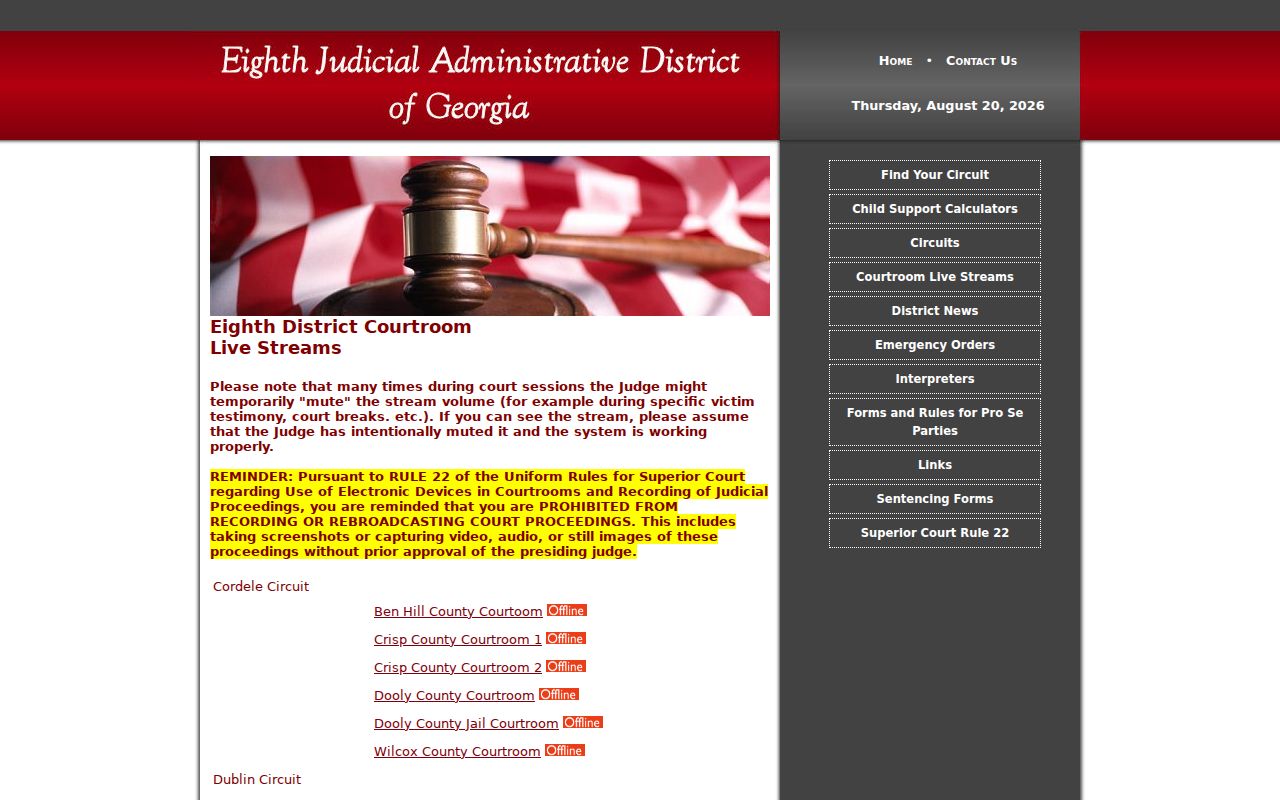
A stream cannot replace the Baldwin criminal docket because it cannot be searched for charges, entries, or disposition and may not be archived.
Baldwin Criminal Circuit Context
Baldwin Superior Court works within the eight-county Ocmulgee Judicial Circuit. The circuit publishes judges, orders, and calendars, and it specifically cautions users to verify a Baldwin setting with the clerk. That warning matters when a judge rotates between counties or the annual calendar changes.
The official Ocmulgee Circuit directory provides the source view shown below.
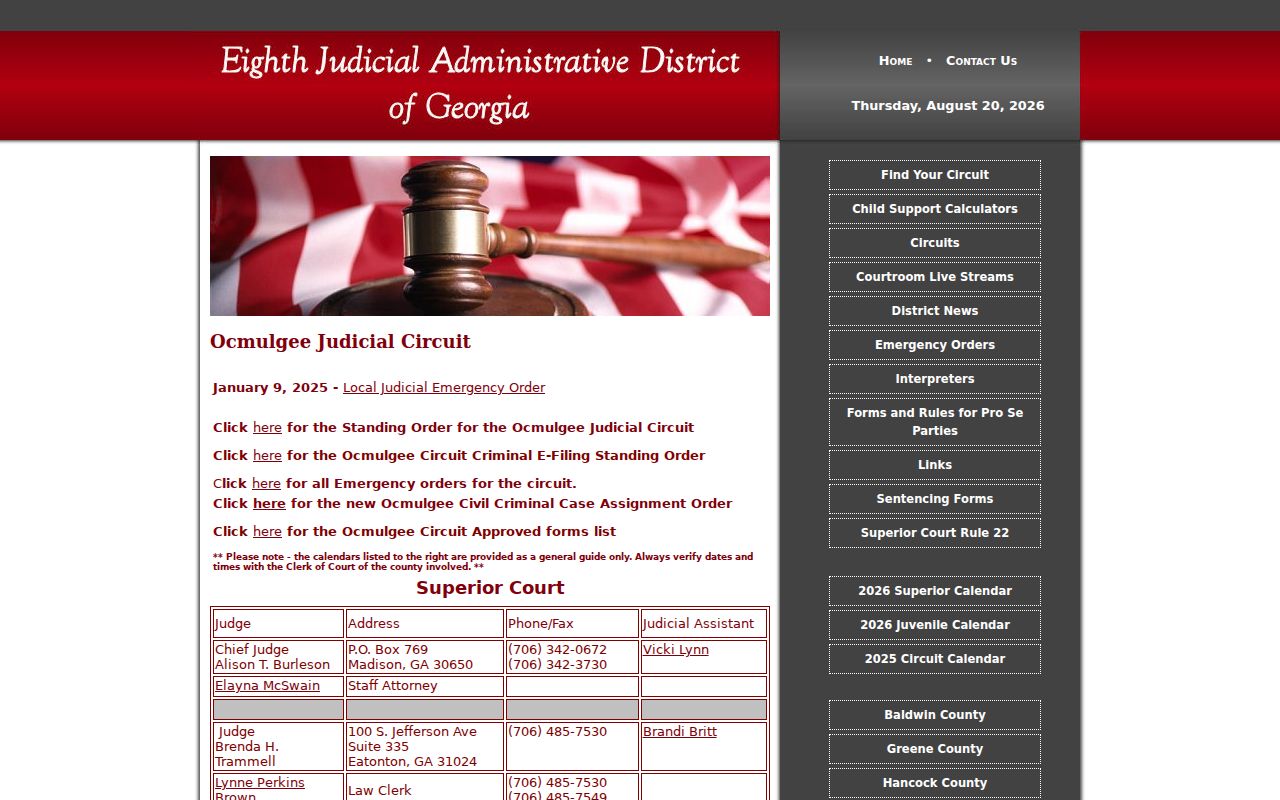
Use the circuit material to understand assignment and calendar context, then return to the Baldwin case record and clerk for the controlling case-level notice.
Sealed Dockets and Public Access
Ordinary Baldwin criminal case information is reached through the designated provider or clerk. Public access does not mean anonymous portal use, free document images, or access to every filing. Sealed papers, restricted criminal records, and confidential juvenile matters do not follow the ordinary search path. When a known case does not appear, check spelling and court class, then ask the custodian what public confirmation may be provided.
Key Rules:
O.C.G.A. § 35-3-37 permits eligible criminal-history restriction and, with a proper order, sealing that can reach court indexes and calendars.
Georgia e-filing standards address public access, sealed submissions, and limits on sensitive identifiers.
Uniform Superior Court Rule 22 separates public observation from permission to record or rebroadcast a proceeding.
To obtain the charging instrument or order behind an event, record its date and title and ask the clerk for a plain or certified copy. Do not try to bypass a restriction. Exact Baldwin copy charges were not published in the sources inspected, so request a current quote and turnaround estimate.